Greetings from Liberty and welcome to the third installment of our Chinwag bagatelle exploration. In case you haven’t been following, here are links to the first two installments.
A new word, demonic
We explored the word “chinwag” on post two using our musical cryptogram. In this installment we worked with the word “demonic” sent in by our good friend Garry Eister, composer of extraordinary music, many featuring the guitar. Thank you Garry.
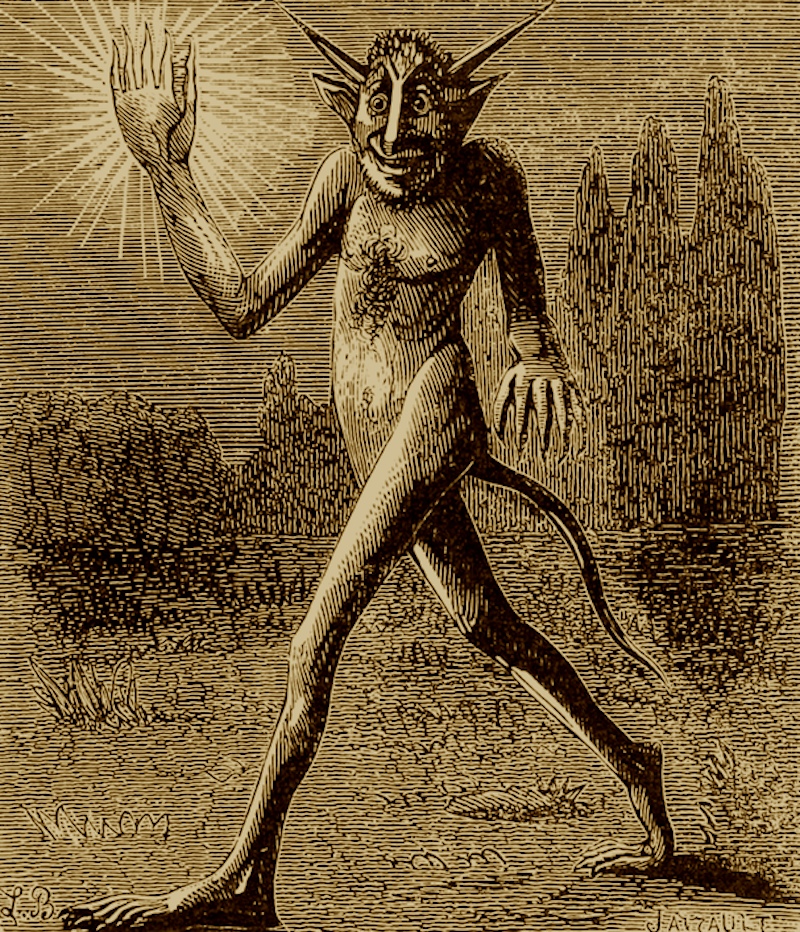
After Garry suggested using the word demonic, it of course came up in my world that same week. I had begun listening to another podcast called Monster Talk, a science show about monsters, since the Chinwag had finished. I listened to their March 16 and 23 episodes called Demon Sex in Medieval Times that featured an interview with a historian named Dr. Eleanor Janega. I learned that the simple definition of a demon is a fallen angel and that one way to avoid demons is to turn them into something imaginary. That reminded me of the Masonic non-belief in black magic as their way to avoid having a spell affect them. But not to fear, our wagatelle word demonic has turned out to be quite fun, like a chocolate ice cream cone. I’m hoping that your imagination will be active while exploring the Chinwag wagatelle.
The musical spelling for demonic
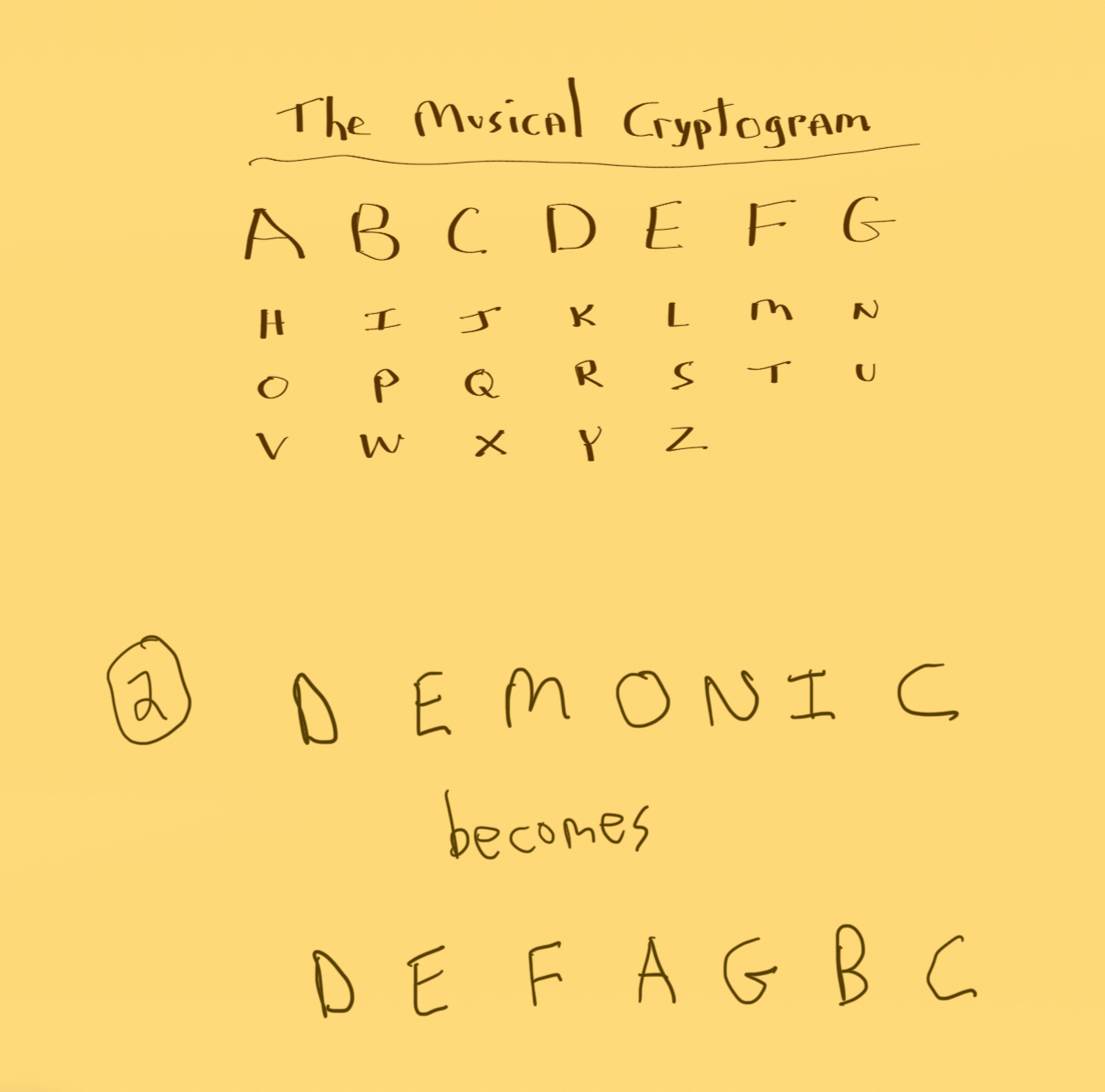
Here is what the musical cryptogram looks like for the word demonic.
Here is what those notes look like.
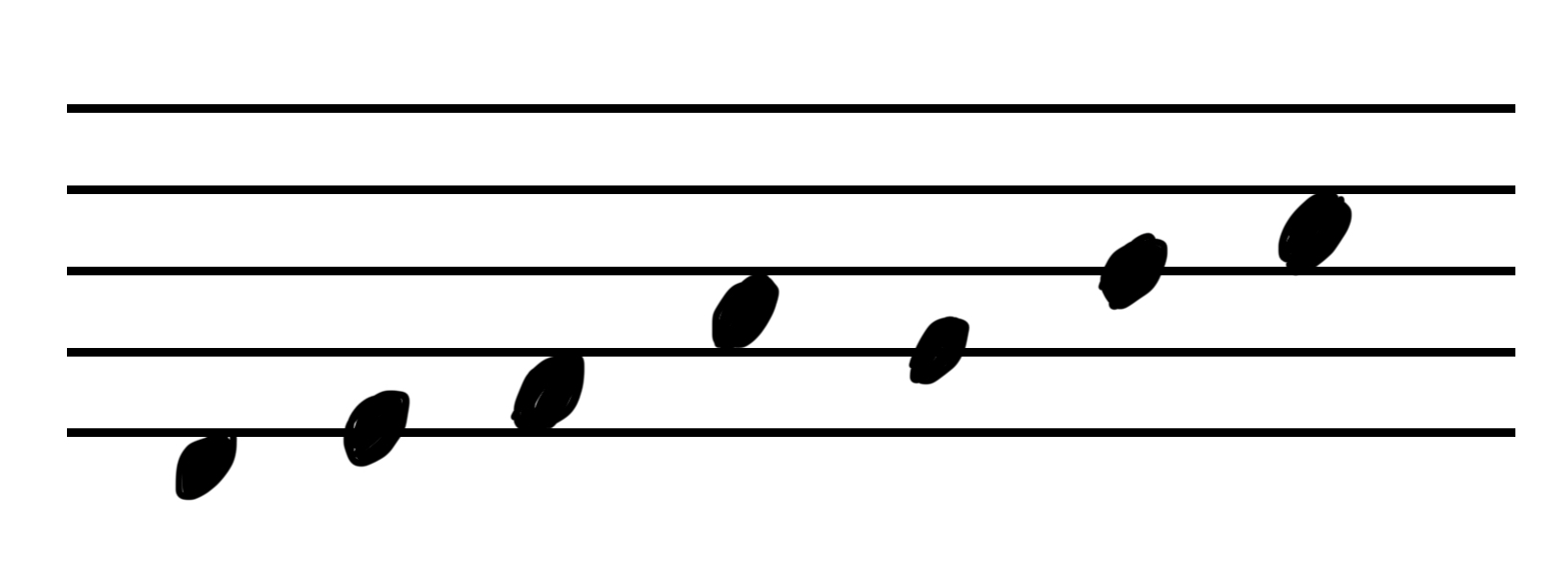
Those notes on the first voice, the banjo
After hearing those pitches and playing them at the same tempo as the first word, chinwag, they sounded bright and were ascending up, which made it even brighter. I thought, “Is this what demonic should sound like?” Of course it should.
Here is what the banjo line became from those pitches.
The Devil’s interval
As you can hear, I threw in a couple of dissonant, demonic moments to add to the consonant, ascending line. In western music history there was an interval called the devil’s interval or in latin, diabolus in musica. The interval is called a “tritone” because it is made up of three whole tones. For more on this sound go here. But the devil’s interval is not the only place in music where dissonance can be found. I’m using two harmonic intervals that are both called a semitone or a minor second or a half step. A harmonic interval is when two pitches are played simultaneously. Two notes being only a half step apart are as close as two pitches can be that aren’t microtonal.
Here’s a semitone on the banjo at the end of the first phrase. It goes by quickly so don’t blink. The two pitches are G and Ab.
The banjo line plays phrase 1 and then it plays a similar phrase 2 that ends with the dissonant semitone. Phrase 3 begins with the same ascending cryptogram notes as phrase 1 but then ends on phrase 4 with a descending line. Then a repeat of the first three phrases with an ascending line on the last phrase 8. Here’s what the midi notes look like.

Adding a second voice, the saw sound in the sampler
The second voice I added was the saw sound in the sampler. The reason I call this the saw in the sampler is because when you load a sound sample into a sampler you can play the sound with different pitches from your midi keyboard. Later I’ll add a sixth voice called the saw sample which is a recording of someone playing an actual saw. The saw in the sampler line closely follows the banjo, but not as note-y at the end of phrases. This sequence, the order of adding voices, is following what happened on the first word, chinwag. Here’s what the saw sound in the sampler sounds like:
This line with this saw sound reminds me of the sound on the Good Humor ice cream truck that came down our street, Symington Avenue, in Paradise. On a side note, here’s a story about the jingle that the Good Humor ice cream company used. The melody was from a song called, “Turkey In The Straw,” which came from an old Irish ballad called “The Old Rose Tree.”

Here is what the banjo and saw in the sampler sound like together.
Here is what the midi lines look like.

Adding the third voice, the tuba
The tuba is still in a supporting role serving a rhythmic and harmonic function. It is paying attention to the melodic lines performed on the banjo and saw in the sampler. It descends at the end of the first phrase and ascends at the end of the second phrase, like the banjo and saw in the sampler do. Here is the tuba line soloed.
Here are the midi lines for the banjo, the saw in the sampler and the tuba.

Adding the fourth voice, the bagpipe
On the previous word, chinwag, the bagpipe was playing something counter to the banjo and saw. On this new word, demonic, I wanted to try something that sounded more in line with the traditional way of making sound from the pipe. The phrase starts with an ascending pick-up to a single note drone with each four bar phrase ending with a three note lower chord. I thought the sound and part worked well under the banjo and saw. What do you think? Here’s the bagpipe soloed.
Here’s what the midi line on the bagpipe looks like.
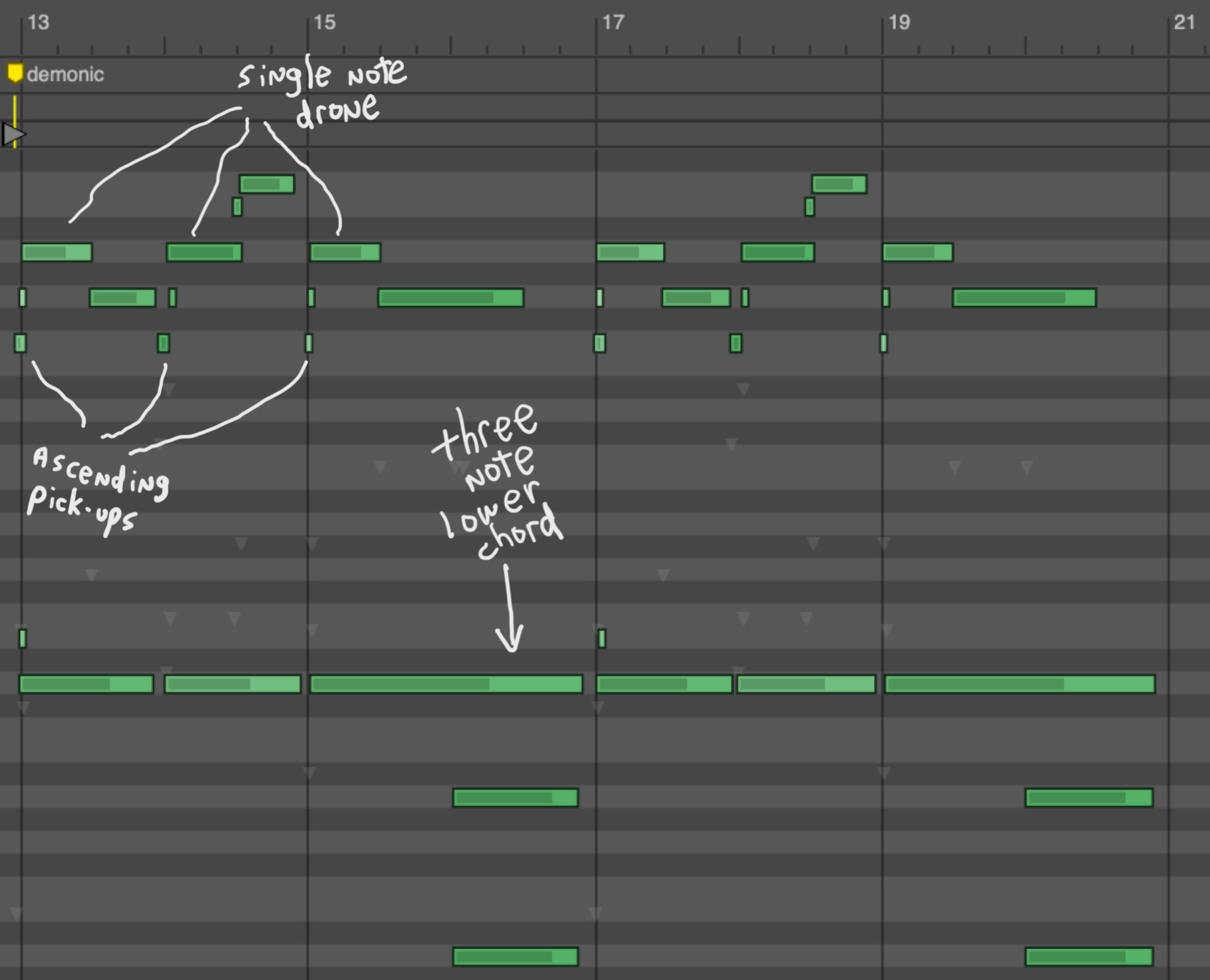
One thing to mention here is that this part probably has notes added that may not be found on every bagpipe. When the part plays the three note lower chord, it can do that with the bagpipe voice in the sound library but those notes may not be possible to play on all bagpipes. Playing notes outside of the range of the instrument is something that happens sometimes when using sound libraries. But if it sounds good in the midi mock-up, I sometimes let it go. This part is one where I’m letting it happen.
Adding the fifth voice, the cowbell
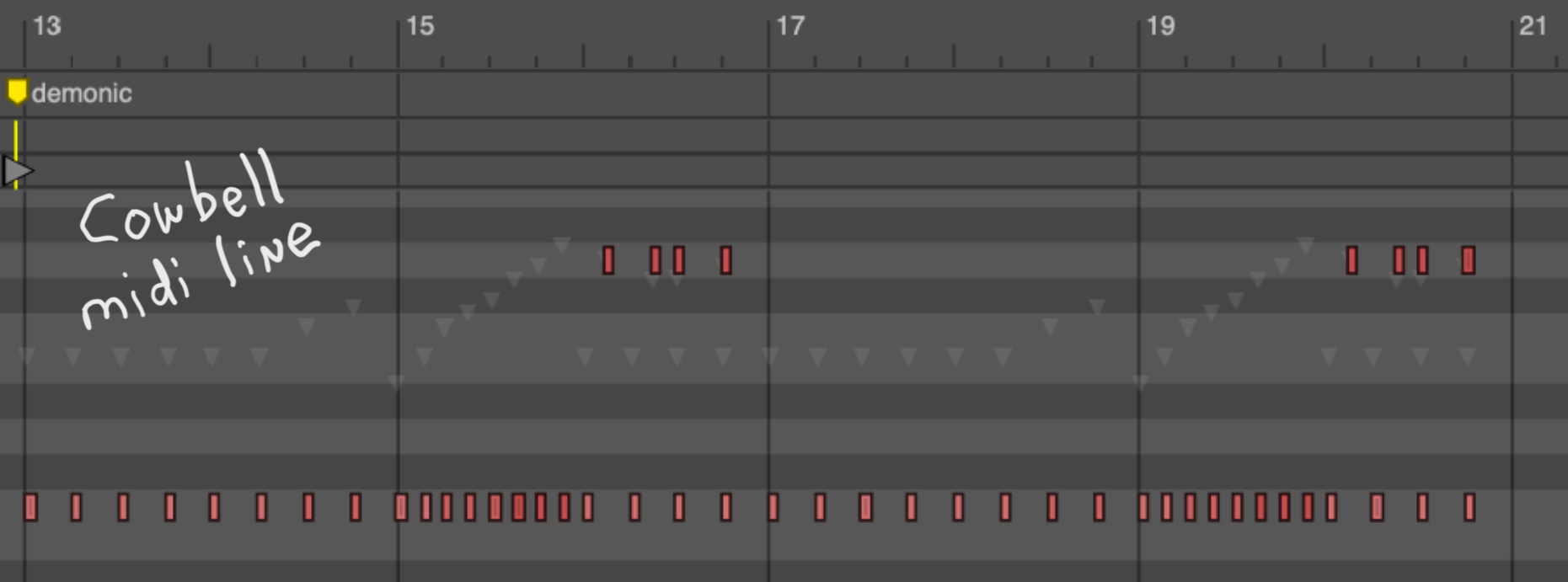
The cowbell is continuing a mostly steady quarter note pulse with a couple of eighth notes thrown in. It is a fun instrument to play. Here is what the midi line looks like.
Adding the sixth voice, the saw sound
The saw sound is used as a fill instrument that could be played on a theremin as well. Paul Giamatti from the Chinwag loves the theremin and even played one when the Chinwag did an episode with a live studio audience. Stephen Asma would play his electric blues guitar for that electric guitar/theremin sound. Here’s what the saw sound sounds and looks like:

All of the sounds together
And finally, here are all of the sounds or voices together with banjo, saw in the sampler, tuba, bagpipe, cowbell and saw sound.
Now we need another word, and I’d like to add the next one. On the Chinwag, Paul and Stephen spoke fleetingly and sometimes tongue-in-cheek-ly about Madame Blavatsky, a Russian and American occult writer and mystic who co-founded the Theosophical Society in 1875. I’d like to try using her last name, Blavatsky. The name already has two musical letters in it, “a” and “b”.
If you have thoughts about our Wagatelle please mention them in the comments below.
A question to ponder- is it a cryptid or a scriptid???
See you in about two weeks.
Billy


 Billy Kemp
Leave a comment