
In my last post, we ended with the musical notes for the word CHINWAG. To reiterate, the musical spelling for CHINWAG is C_A_B_G_B_A_G. We mentioned that even if you don’t know how to read music, you can still see how the melodic line moves. Here’s what those notes look like:

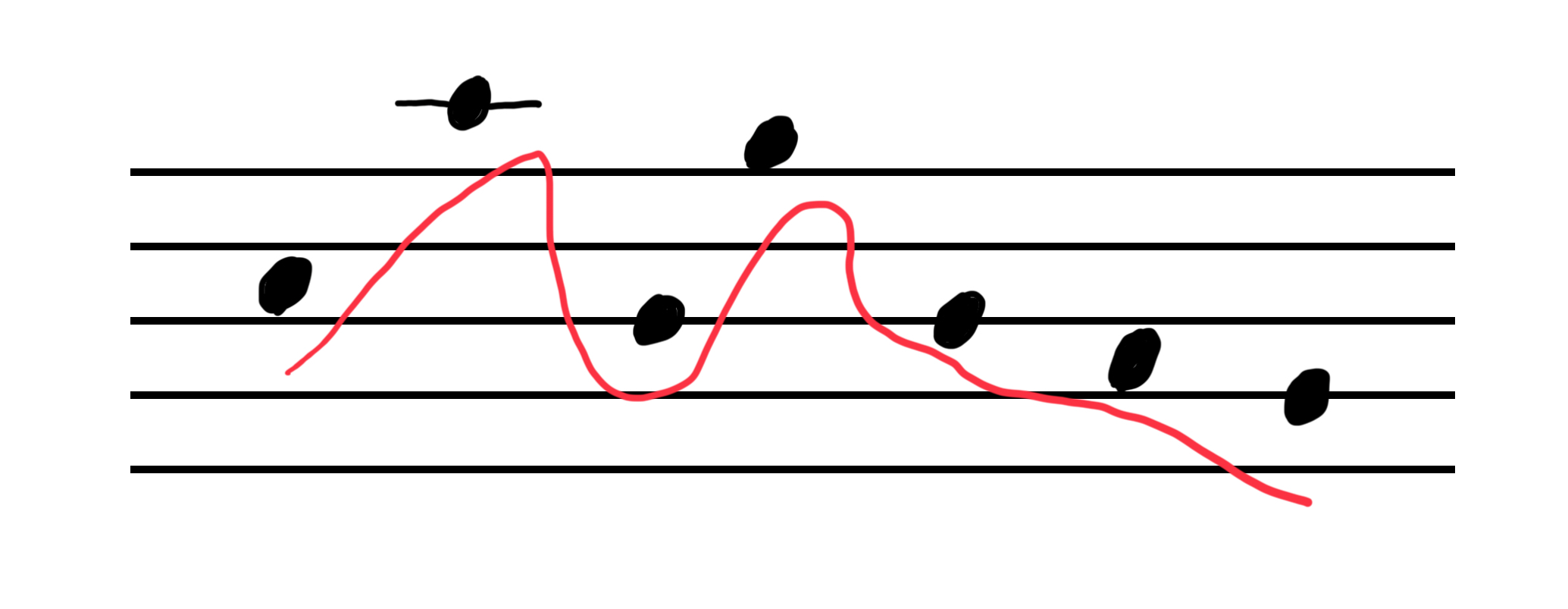
The first example is a close melodic line while the second one is an open melodic line. Don’t forget that these notes or pitches were derived from a musical cryptogram where the non-musical letters equate with a musical letter.
Listen To A Chinwag Episode and Submit A Word
For our musical cryptogram composition exploration (mcce), we’ll be coming up with different words that reflect something that’s a part of or related to the podcast, The Chinwag. If you would like to contribute a word to our mcce, please have a listen to The Chinwag, and then submit one that strikes you at the leave a comment section at the bottom of this post. Many of the episodes speak about crypids and aliens as well as other esoteric stories. Here are a couple of episode links, one on aliens and one on Bigfoot. The one with William Shatner was also a good one.
Since a bagatelle is a short unpretentious instrumental composition, let’s see if five words will be enough for our mcce. Let’s call our bagatelle a wagatelle in honor of The Chinwag.
Methodology For Our First Word
The first word for our mcce or wagatelle is CHINWAG. I chose this word to get us started. Here’s how I generally create when trying to work with musical notes that have come from a musical cryptogram.
Above are two examples of the musical notes for the word CHINWAG. I decided to choose the open version, or example two, because when I played the two possibilities for my wife she immediately said, “I like the open one.” Lesson one-listen to your audience.
Next I played the pitches on an instrument that will be in the wagatelle. Our mcce is going to feature banjo, bagpipes, tuba, saw and cowbell. Those are instruments or sounds that Paul Giamatti and Stephen Asma, the hosts of The Chinwag, said that they would like to hear played together.
When I already know what the instrumentation is going to be, I’ll usually pick one of the sounds that will most likely be playing the melody to work with first. Just a reminder, the three main elements of music are: melody, harmony and rhythm, but not necessarily in that order for their importance or weight. I used to think that melody was the most important element in my creative process. But then at some point, rhythm became the most important element in my process. But often, the elements and process are fluid.
The First Instrument-Banjo
I chose the banjo sound to work with first. I played the notes, C_A_B_G_B_A_G, in an open pattern until they seemed like they were in a pleasing rhythm. The tempo I decided on is a quarter note at 126 bpm or beats per minute. That tempo is the same tempo as The Chinwag theme. Sometimes reaching that pleasing place can take a while. For these notes, it happened within ten or fifteen minutes. Here’s what the banjo sounds like. Keep in mind that at this point all of the sounds are coming from a sound library and played on a midi keyboard.
The first three short melodic motifs use the exact notes as in example two above, the C_A_B_G_B_A_G. You may ask, where did that rhythm come from? My answer would be it came from the order of the notes, the tempo and the repetition of playing it over and over until it felt pleasing. Since bagatelles are generally light in character, I thought it best to have a spirited rhythm.
The last four notes did not come from the musical cryptogram. They came from the opening four notes of the Chinwag theme. Interestingly, those four pitches are similar to the opening four notes from Jimi Hendrix’s, “Purple Haze.” Those notes also happen at the end of a phrase in the Janis Joplin song, “Move Over” on the line, “better move over.” Here’s what those notes look like:

The Second Instrument-Tuba
The second instrument I chose to work with was the tuba. I chose the tuba because I hear its role as supporting the melody on the banjo, rhythmically and harmonically. The tuba functions as a lower sounding instrument because of its range. What do I mean by rhythmically and harmonically? Remember the three elements of music- melody, harmony and rhythm? The melody is being played by the banjo. So I thought about the other two elements, rhythm and harmony. To help propel the melody forward I decided to drive the tuba with staccato or short quarter notes (steady rhythm) and end with two additional short notes reinforcing the melody and rhythm on the banjo. The pitches I chose on the tuba come from thinking about what the harmony is under the melody. Harmony is referring to the chords in our wagatelle. I think of harmony as being vertical versus melody being horizontal. A chord is three or more notes played simultaneously. When you look at a chord in standard notation, it appears vertical.

So when I wrote the tuba part, I was thinking harmonically though the tuba isn’t playing chords. With just a melody and a single note underneath, the banjo on top and the tuba on the bottom, a harmony or chords are implied even though all of the notes of a chord are not present. Here’s what the tuba sounds like.
Here’s what the banjo and tuba sound like.
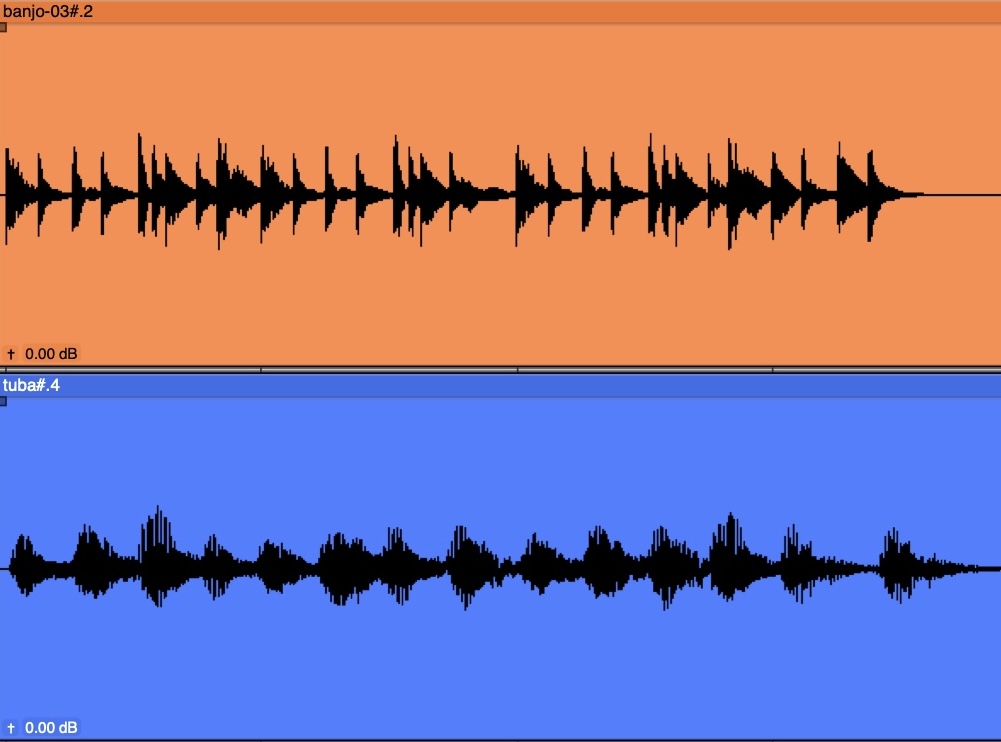
Here is what the banjo and tuba look like in Digital Performer, my digital audio workstation or DAW. Notice the different rhythms.
The Third Instrument- Bagpipe
I chose the bagpipe as the third instrument to work with because I thought, bagpipes usually have a drone or sustaining note on the bottom with melodic sound sitting on top. At first I tried to use the instrument traditionally, but the drone didn’t seem to work for my tastes. Then I tried playing the melody along with the banjo, but the notes were moving so quickly that they were a blur. Then I thought let’s try playing something slightly counter to the banjo melody and also have some sustained chord sound or harmony. Remember with the banjo and tuba, the harmony was just implied. The bagpipe could solidify the harmony. I ended up thinking about the chords or harmony and played a quick ascending line that functions as a set up and counter to the banjo melody, as well as a couple of single note pads and an ending with a couple of two note (an interval) pads. A pad is a sustained sound that can add harmony to a piece of music. Here’s what the midi info and audio look like.

As you can see on the midi image above, the bagpipe plays the ascending line three times, each one followed by a single note and then two double notes or intervals. Here’s what the bagpipe sounds like.
Here’s what the banjo, tuba and bagpipe sound like.
The Fourth Instrument- Cowbell
The cowbell has been made famous by Will Ferrell from a Saturday Night Live sketch back in 2000. It’s worth a visit here. The cowbell, a percussion instrument, does have pitch but is primarily used as a rhythm sound. I decided to use the cowbell as mostly a steady quarter note pulse. here’s what the cowbell sounds like.
Here’s what the banjo, tuba, bagpipe and cowbell sound like.

The Fifth and Final Instrument – Saw
There was an ensemble I used to see at festivals in DC, The New Sunshine Skiffle Band, when I lived in Baltimore, that had a saw player, and I always enjoyed seeing and hearing the saw making sound. It’s microtonal and reminds me of a theremin. The Chinwag theme features a theremin which makes you think of aliens on a spacecraft. The saw can inspire that same feeling and image. I first found some saw samples online for our wagatelle. Then I put one of the saw samples into a sampler. I decided to use the actual saw samples for fills and used the saw sound in the sampler for actual pitches and fills. A fill is sound that happens at the end of a musical phrase and just before the next phrase. The fill, fills the space between two phrases. The saw sounds are also reinforcing the bagpipe pads.
Here’s what the saw sampler sounds and looks like.

Here’s what the actual saw sample sounds and looks like.
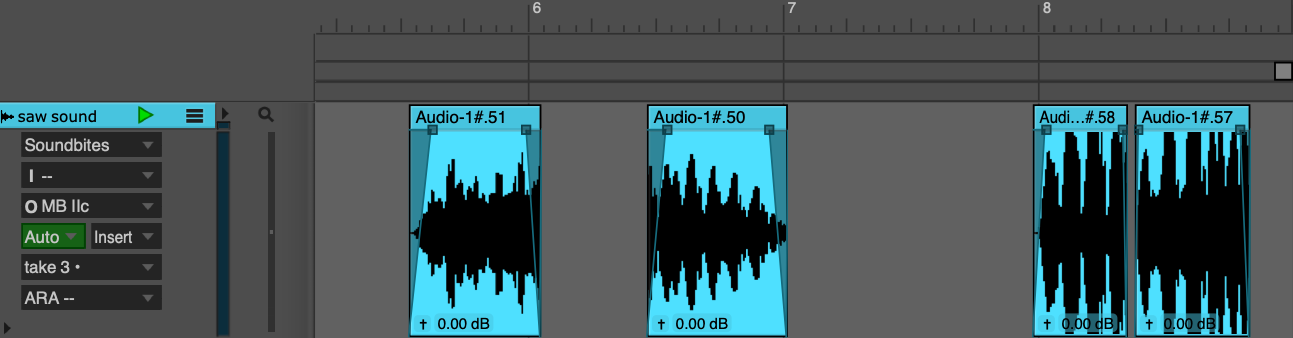
Here’s what the saw sampler and the saw sample sound and look like together.

Here is an image showing how the saw sounds are playing similar rhythms with the bagpipe.

Here is how the bagpipe, saw sampler and saw sample sound together.
And finally, here are all of the sounds together with banjo, tuba, bagpipe, cowbell and saw.
So now we have our first word, CHINWAG, in musical form. The musical cryptogram serves as an alchemical solution, lining up perfectly with the mission of Paul and Stephen from the Chinwag.
Thanks for following along. Please send in a word you would like to hear in our wagatelle.
See you in about two weeks…


 Billy Kemp
Leave a reply to Billy Kemp Cancel reply